The Kansas Association of Biology Teachers is a group of current and former educators interested in advancing the practice of science teaching within and beyond the borders of the state of Kansas. Through fellowship amongst members, the sharing of information, and the free interchange of ideas, our objective is to foster passion and appreciation for the life sciences.
Fall Conference: November 18, 2023
(full agenda & registration information are found below infographic)
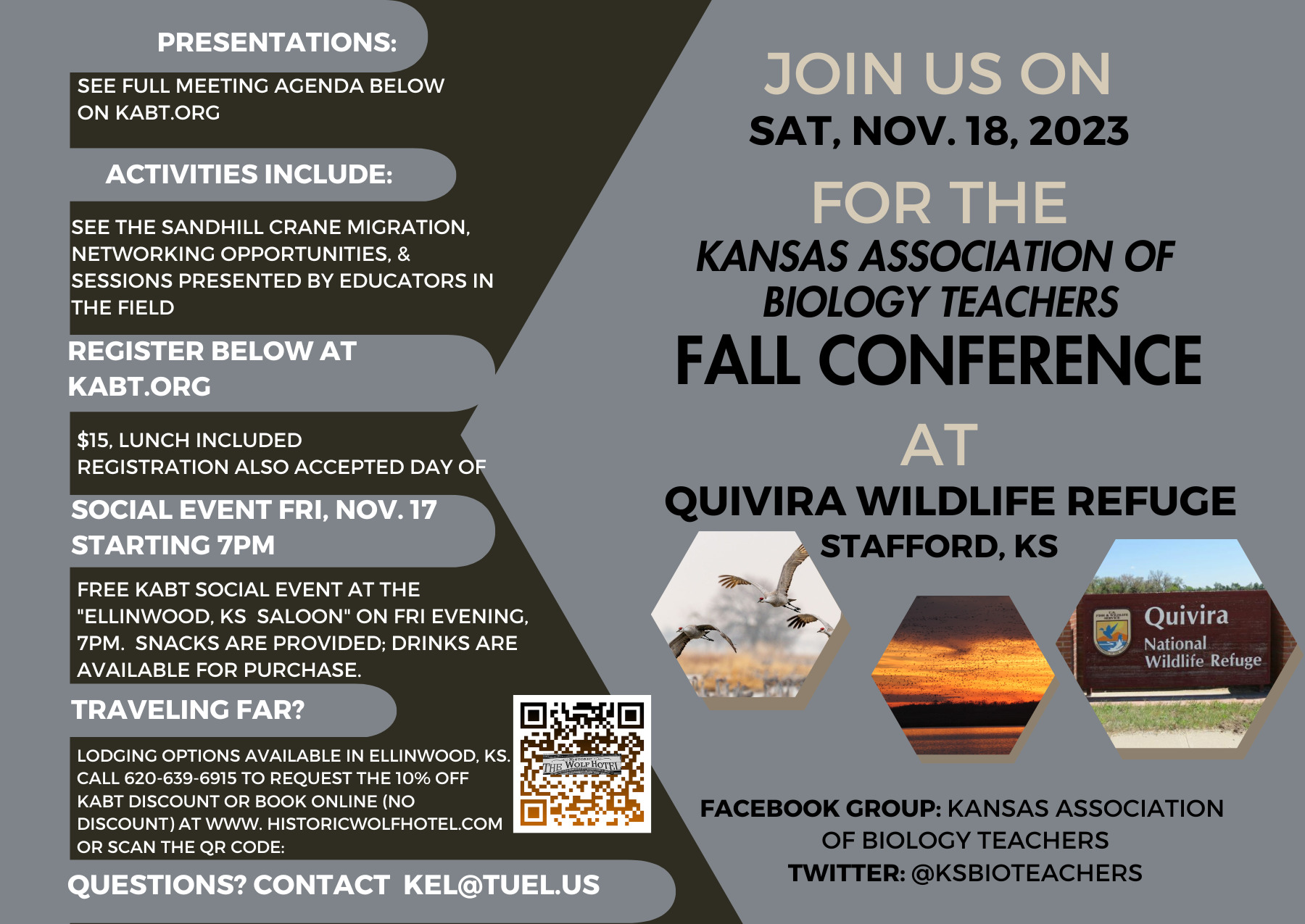
11/17 (Friday) – KABT Social at 7pm.
Ellinwood, KS “Underground Saloon & Bar.” Google Maps link. Snacks are provided. Drinks are available for purchase.
Saturday Agenda
| Time | Presenter | Topic | Description |
| 7:30 – 9:00 am Parking near Big Salt Marsh at Quivira Wildlife Refuge | Mandy Kern, Kansas Wetlands Education Center | Wetlands Bird Watching Meet in parking area west of the Big Salt Marsh (that is most likely where the cranes will be). Map | Mandy will have the KWEC van and spotting scope to observe Sandhill Cranes, maybe Whooping Cranes, as well as many other species. Bring binoculars if you have them! |
| Presentations at Quivira Visitor’s Center** | Link to Visitor’s Center map | **If there is a government shutdown on 11/17, the Visitor’s Center will be mandated closed. We will instead meet at the Ellinwood, KS Historic Wolf Hotel Conference space. | **Google Maps link for our government shutdown Plan B |
| 9:30 – 10:00 | Andrew Taylor, Olathe Northwest | Hydrophobic Marvels: Using Water Models to Unravel the Self-Cleaning Secrets of Lotus Leaves Discussion.Science Content. | Participants will learn how models can help students make intuitive sense of engaging phenomena. |
| 10:05 – 10:15 | Erika Martin, Emporia State University | Student response to inquiry-based biology Short Presentation.Pedagogy, instructional strategies, Assessing and evaluating learning. | Short discussion explaining the inquiry-based teaching methodology, then results comparing students who either participated in the inquiry-based course or a ‘traditional’ course |
| 10:15 – 10:45 | Sarah Henning, Campus High School | Strategies for Helping English Language Learners Access Life Science Concepts Discussion.Pedagogy, instructional strategies. | Discussion with teachers of strategies they already use with ELLs and whether or not they believe these to be effective. I will present research on strategies for teaching ELLs and discuss how these strategies can be practically implemented in secondary life science classrooms. I will work through teachers’ frustrations and questions in a discussion format. |
| 10:45 – 11:55 | Zack Shinkle, Derby High School | Dig Field School Laboratory or field exercise.Pedagogy, instructional strategies, Science content, Professional development opportunities. | Overview of the DIG field school summer opportunity. We will also walk through a microfossil sorting activity. |
| Noon – 1:00 pm | Lunch! | – Brats, hamburgers & veggie burgers- Chips & cookies- Water and soda(Rain or Governmental Shutdown Plans: Catered lunch at the hotel meeting space in Ellinwood, KS) | We will be grilling at the Quivera Wildlife Refuge where the meeting takes place. Munch a brat and take a birding stroll if you so desire. |
| 1:00 – 1:30 | Jack Treml, KU Edwards | Approaching Experimental Design in molecular biology using Restriction Enzymes Discussion.Pedagogy, instructional strategies, Science content. | We will examine how experiments are designed and how results are described in scientific papers. Includes a response to peer review activity. (AP Biology/Intro Bio level) |
| 1:30 – 2:30 | Keynote – Mandy Kern, Kansas Wetlands Education Center | Application of Merlin – and Other Great Nature Apps Laboratory or Field Exercise.Pedagogy, instructional strategies, Science content | 375 of the 450 bird species found in Kansas have been documented at Cheyenne Bottoms. Merlin is a great citizen science tool used to identify and document birds. Tablets will be provided for participant use. We will ID birds using mounts, photos that can be set up along a nature hike, any live birds witnessed on our hike, and using bird song calls. Bird watching techniques and bird adaptations will also be explored. As time allows, we will delve into some other great apps like iNaturalist, Seek, and Star Chart. Resources, programs, and field trips offered by the Kansas Wetlands Education Center are free for teachers. Come learn how we can assist your students experience wetlands! |
Please contact kel@tuel.us for questions about either membership or Fall Conference.
If you have any general KABT questions, comments, or inquiries, please contact us with the button below: